The clinic said my 38-year-old eggs were the problem. And raised donor eggs at the second visit. Then I found out what my eggs had been developing in for 90 days — and why nobody had mentioned it.
Why your next cycle may already be decided — not by your age, not by your protocol, but by the fluid your egg has been sitting in for 90 days before anyone ever measures it. And why that window is open right now.
- Why "poor egg quality" is rarely the whole story — and the 90-day environment almost no clinic explains
- The fluid your egg develops in mirrors your blood. What's in your blood is what surrounds your egg
- One daily liquid. No pills. Built for the window that happens before the retrieval, not during it
How she did it — without another 20-pill stack, without a single claim about "improving egg quality." Just the part of the biology no one had shown her.

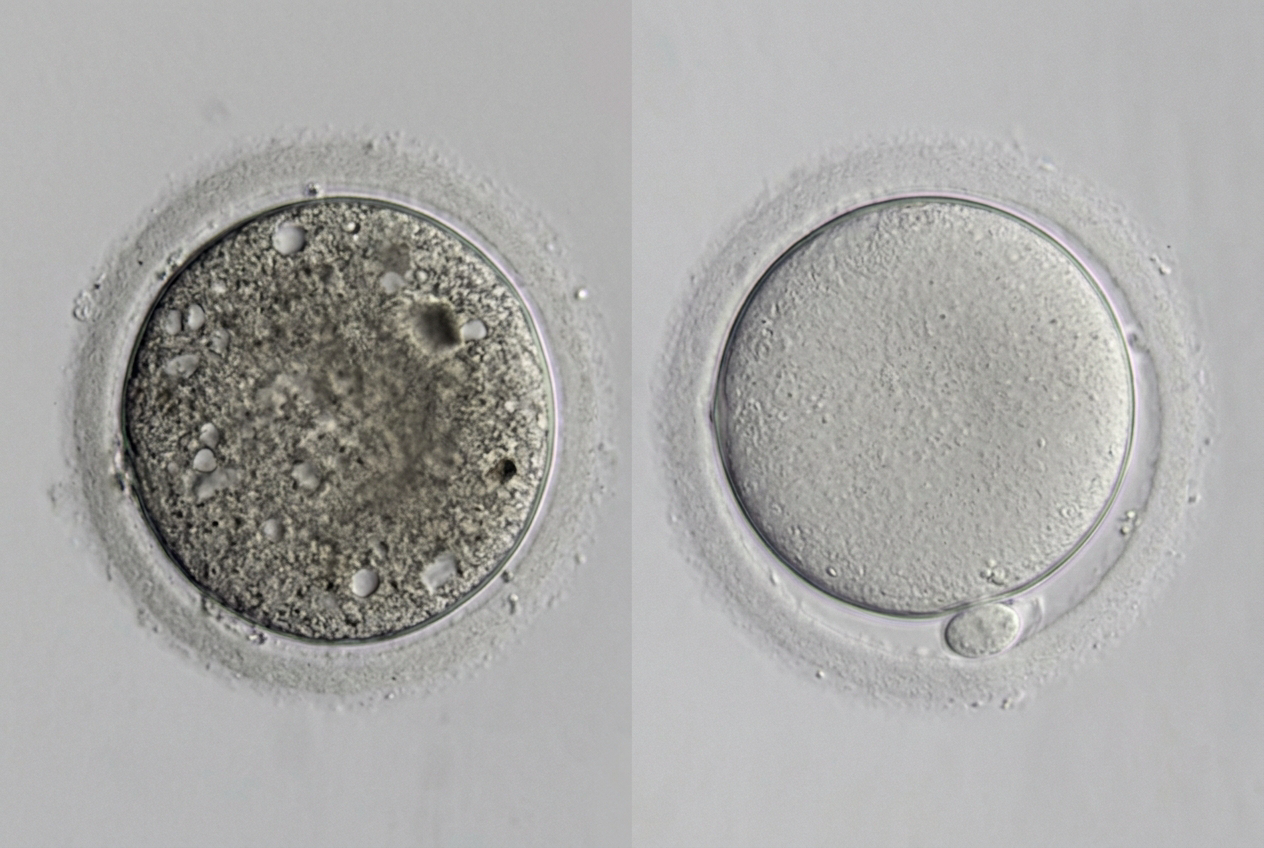
The doctor turned her monitor toward me and pointed at a cluster of grainy, uneven circles.
"These are your eggs from this cycle. See how dark and grainy they look?"
Then she pointed to a second image beside it. Someone else's eggs. Round. Smooth. Bright.
"This is the quality we need for a viable embryo. Yours… aren't there."
A pause.
"With an AMH of 0.7 and this egg quality, I'd start thinking about donor eggs."
I was 38. Second IVF cycle. Zero embryos to transfer.
That sentence split me in two.
If you're trying to get pregnant right now…
If a doctor has talked about your "ovarian reserve" like it's a tank running dry…
If you've heard the words "poor egg quality" — and haven't been able to think about anything else since…
If you've watched your numbers fall apart one stage at a time: retrieved, then mature, then fertilized, then nothing to transfer…
If you're the one who reads the studies at 2 a.m. and walks into every appointment with questions the doctor doesn't expect…
Then what I found in the twelve weeks after that appointment might matter to you.
My name is Danielle. I'm a project manager just outside Boston. And eleven months ago I was sitting in the clinic parking lot with my hands on the wheel — unable to drive, unable to call my husband, unable to do anything but stare at the report on the passenger seat.
I'm not telling you my story for sympathy.
I'm telling you because I finally found out what my eggs had been developing in. And it was not the reason three different people in white coats had implied.

Everything was "in range." Except the result.
Let me back up.
My husband and I started trying in the summer of 2024. Regular cycles, 28–29 days. Positive ovulation tests every month. "Everything looks fine," the OB kept saying. "Give it time."
At 36, I thought: okay. We'll give it time.
Off the pill. Prenatal. Ovulation strips. A cycle app. "It just takes time at your age," everyone said. So we waited, and tracked, and waited.
Bloodwork and an ultrasound. AMH: 0.7. FSH: 11.4. "A little below average for your age," the doctor said, "but not dramatic. Keep trying." I went home and read about "diminished ovarian reserve" until 3 a.m.
Month 14: First IVF
Two rounds of failed medicated cycles later, we moved to IVF. Weeks of injections. The bloating. The 6 a.m. monitoring appointments. And then the hunger-games calls that I'd rehearse in my head for days before they came.
Eggs retrieved: 8.
Mature: 5.
Fertilized: 3.
Made it to blast: 0.
They arrested by day three. Nothing to transfer. Nothing to freeze.
The doctor said the sentence that would follow me for a year: "Your response isn't the problem. It's the egg quality."
Month 19: Second IVF
New protocol. Higher doses. I did everything they told me. And I quietly added a shelf of supplements on top — CoQ10, inositol, a prenatal, DHEA, vitamin D, omega-3s — because doing nothing felt worse.
Eggs retrieved: 6.
Mature: 4.
Fertilized: 2.
Made it to blast: 0.
Same story. Fewer eggs. The same collapse at every stage.
That's the appointment where she turned the monitor toward me. Where she said "start thinking about donor eggs."
My ovaries, she told me, were "behaving like a 44-year-old's."
I asked her why. What was actually wrong with the eggs. Whether there was anything I could do.
"You have poor egg quality. That's really all we can tell you."
That night my husband slept. I didn't.
I lay there running the same retrieval math I'd been running every night since the call. If I get six eggs again and the same fertilization rate, I need three to fertilize just to have a chance at one blast. But the math never changes. And at 2 a.m. I was back on the same thread I'd bookmarked three weeks earlier — a woman with an AMH of 0.9 who'd gotten two blasts on her third round — rereading her supplement list for the fourth time, looking for the one thing I'd missed.
My body gets there. It makes eggs. But the eggs themselves keep failing. And no one can tell me why.
I had done everything right. And the one thing my body was supposed to just know how to do was the one thing breaking me.
And underneath all of it, the thought I couldn't shake: maybe this was my fault. Maybe I'd waited too long.
All I wanted was one good egg. One. That was the whole ask.
But I also knew this: if we were going to spend what was left of our savings on one more cycle, or make our peace with donor eggs, I would not arrive there wondering whether I'd skipped a step.
Then, before I said yes to donor eggs, I asked for one more opinion.
I couldn't sleep after that appointment. Every night the same thing: scrolling support groups, reading stories that sounded exactly like mine. No real answers.
Then one night, buried in a thread I almost closed, a woman wrote something that made me sit straight up. She said nobody had ever explained to her that the egg she'd retrieve that month wasn't new — it had been maturing for about three months already. And for that entire time, it had been sitting in fluid. Follicular fluid. A fluid whose nutrient composition was determined by her own blood.
She'd gotten a second opinion from an embryologist — not another prescriber, the person who actually looks at the eggs under the microscope. And what that embryologist told her about the fluid changed everything.
I found one who did second-opinion consults and booked it before I could talk myself out of it.
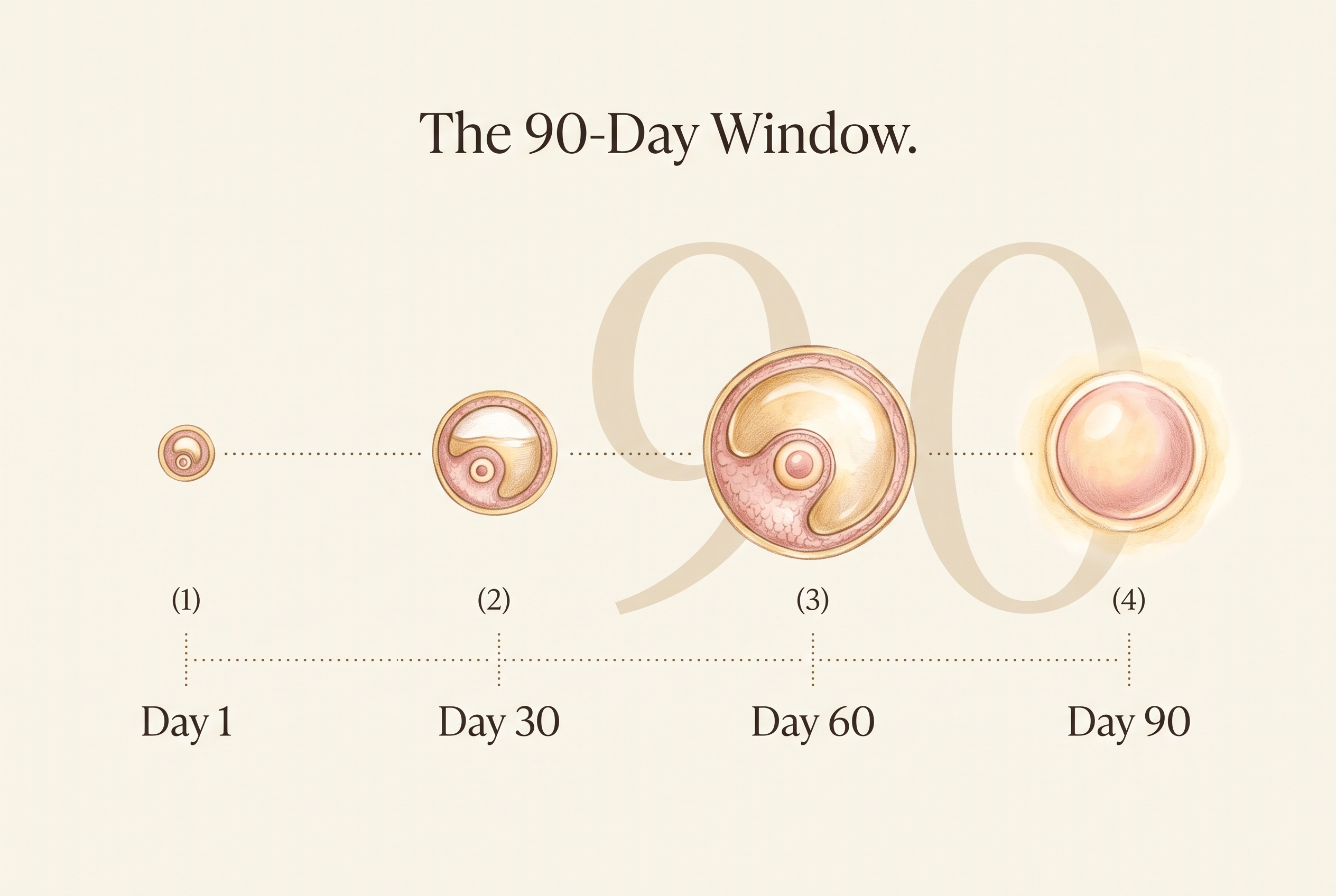
The 90 days — and the fluid — that decide everything
The embryologist I saw had spent twenty years looking at eggs in a lab and making the calls I'd been on the other end of.
She read through my whole history. Two retrievals, AMH falling, "poor egg quality." And then she said the thing no one, in two years, had said to me:
"The eggs we retrieved this cycle didn't start this cycle. They started their final maturation about ninety days ago. And for that entire time, each one was developing inside a follicle, suspended in fluid."
She drew it out for me. When you ovulate, that egg wasn't "created" that month. For roughly the previous 90 days, it had been growing inside a follicle filled with fluid — follicular fluid. Building its energy reserves. Assembling the machinery it would need to divide correctly after fertilization.
And here was the part that hit me:
My eggs hadn't been developing in a vacuum. They'd been developing in fluid. And that fluid had been a mirror of my blood — my depleted, stressed, supplement-chaotic blood — for three months before anyone ever looked at the result.
Then she used an image I'll never forget:
And for the first time, I understood what "the soil" actually was. It wasn't a metaphor.
The soil was the fluid. And the fluid was built from my blood.
And then she said something about my CoQ10 that I wasn't expecting.
"The CoQ10 capsules you've been swallowing every morning? Most of what's in a standard capsule gets broken down by your liver and gut before it reaches your blood in any real amount. The research on capsule bioavailability is not encouraging. So the compound you've been trusting for months may not even be arriving where it needs to go."
That landed. Because I had been taking 600mg of ubiquinol every day for over a year. And nothing had changed.
"But that's not actually the main problem," she said. "Even if every milligram of your CoQ10 arrived perfectly, it works inside the egg. It supports mitochondrial energy within the oocyte. That's a real job. But it's one job. And it doesn't touch the fluid the egg has been sitting in for 90 days. The fluid built from your blood. The fluid whose selenium and zinc and vitamin D levels reflect whatever your body has been circulating. That is the part nothing on your shelf covers."
"Everyone talks about the egg. Nobody talks about the fluid it's sitting in. Your CoQ10 works inside the egg. Your prenatal prepares your body. But nothing in your stack is designed to support the fluid surrounding the egg for those 90 days. That's the gap."
I sat there staring at her. Two years. Two failed cycles. Fourteen bottles of supplements. And not one of them had been aimed at the fluid.
The part of the biology no one explains — and the 90-day protocol built around it.
See the 90-day protocol »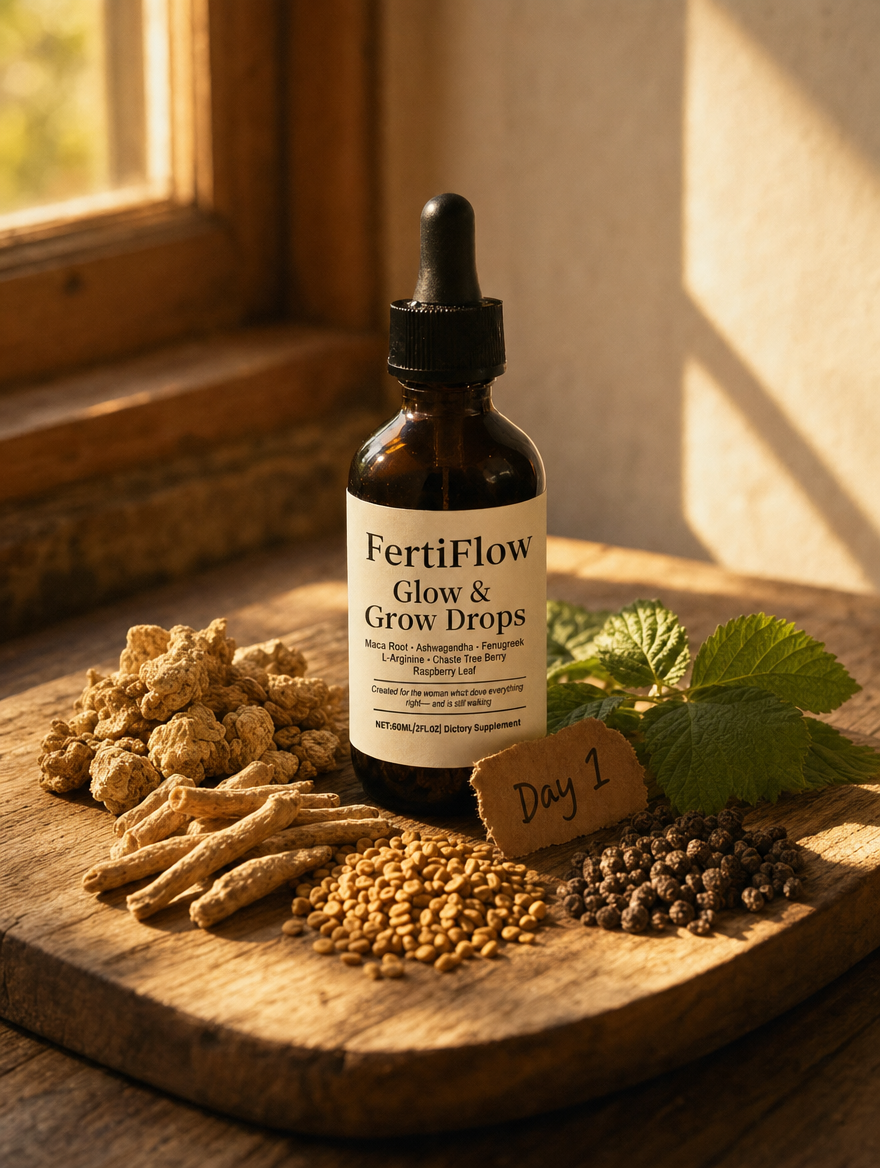
What I did differently
For weeks after that consult I looked for something. One thing. That supported the nutrients found in follicular fluid, in a form I'd actually keep up for 90 days. I didn't want another shelf of capsules. I'd already proven I couldn't get through three months without quitting half of them.
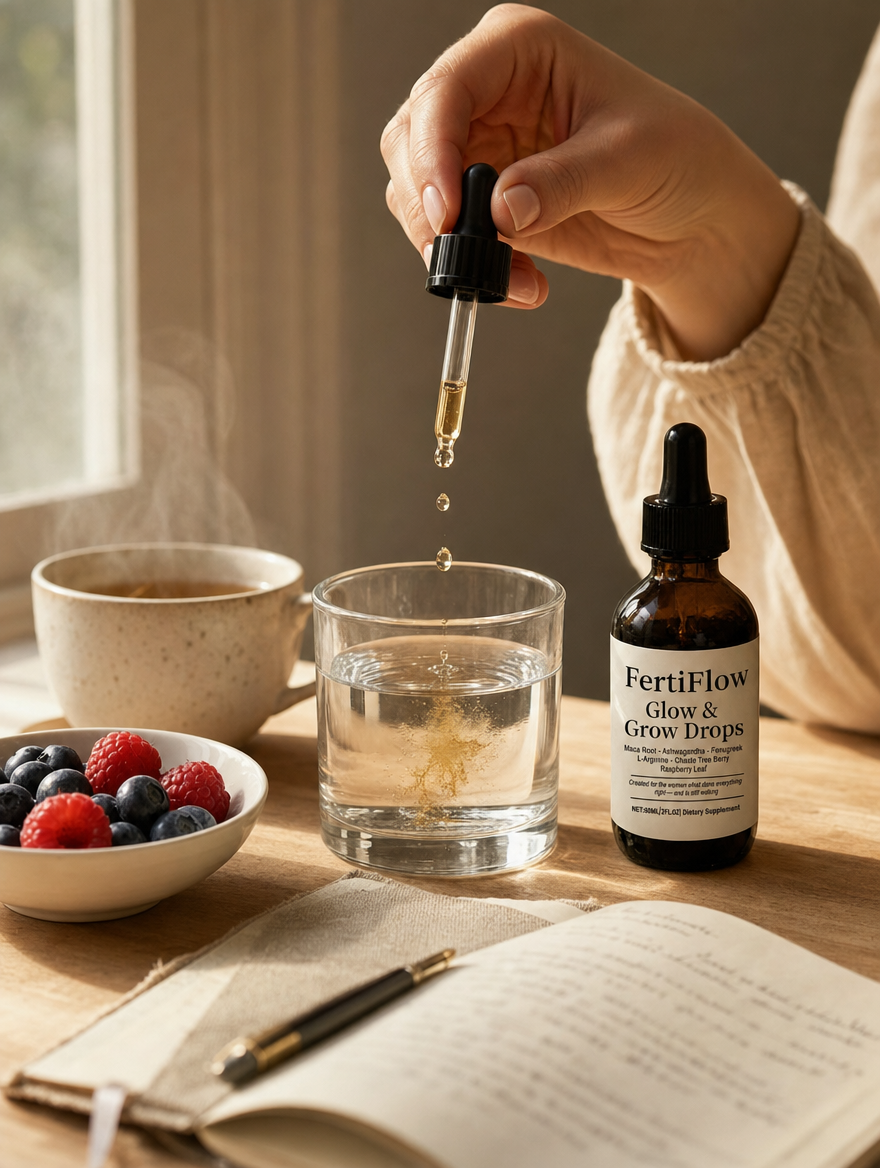
What I found was a liquid formula called FertiFlow Glow & Grow Drops. One dropper a day, in water.
The ingredient list was the first one I'd seen that matched what the embryologist had explained:
For the fluid's nutrient composition:
Selenium (selenomethionine) 100 mcg · Zinc (picolinate) 15 mg · Vitamin D3 100 mcg · Methylfolate (L-5-MTHF) 600 mcg — all nutrients measurable in follicular fluid, at or above their Daily Value, in bioavailable forms that track from blood into the follicle.
For antioxidant protection of the environment:
Vitamin C 100 mg · NAC 100 mg · CoQ10 (ubiquinol) 100 mg — supporting antioxidant capacity in the fluid the egg develops in for the full window.
For daily sustainability:
A liquid dropper. Not capsules. Not 20 pills. One serving, once a day, in water. Because the embryologist's entire point was that consistency across the full 90 days mattered more than any single ingredient at any single dose.
I'll be honest about one thing, because I read labels obsessively and you probably do too: the CoQ10 is 100 mg. Most studies I'd seen used 200–600 mg. It's lower. The company doesn't hide that — they say on their own product page to dose CoQ10 separately if it's your priority. FertiFlow isn't a CoQ10 product. It's a follicular-fluid support product. The CoQ10 is there as a base layer, not as the primary story.
That honesty was actually the reason I trusted it. Every other brand I'd looked at inflated their claims. This one told me what it couldn't do. In a category where everyone promises miracles, the company that published its own limits felt like the first one that wasn't lying to me.
I ordered the 3-month protocol. Because an egg takes about 90 days to mature. No "pregnant in 7 days" nonsense. Anyone who promises that doesn't understand the biology.
That honesty was the reason I finally trusted it.
The first change had nothing to do with fertility — and nothing to do with the fluid yet. It was my blood chemistry adjusting.
I slept through the night for the first time in months. No 3 a.m. spirals. The cortisol fog started to lift. My energy came back. My skin cleared a little.
The embryologist had said this would happen first: the serum shift. What's in my blood changes before what's in the follicular fluid follows. "You're changing the water before the soil changes," she'd said.
My cycle arrived on day 28. Exactly. For the first time in a year, I wasn't holding my breath counting.
At my baseline scan, the clinic noted things were "looking more consistent." Small. But in the right direction.
The embryologist had said this was the transition — the follicles that would become my next eggs were now filling with fluid. And that fluid was being built from blood that reflected two months of sustained daily intake of selenium, zinc, vitamin D, and the other micronutrients.
The soil was changing. The fruit was still growing.

Month 3 (bottle three) — The retrieval
This was the month that counted. Because the eggs that had been recruited at the beginning of the protocol — the ones that spent their entire maturation window developing in fluid built from the blood I'd been supporting for 90 continuous days — were finally ready.
Third retrieval. Same clinic. Same protocol dosing. Same me, one year older.
Eggs retrieved: 7.
Mature: 6.
Fertilized: 4.
Blastocysts: 3. Two of them top-grade.
The embryologist looked at my history and then back at the images. She said, "Something changed. I can't tell you what."
I didn't tell her it was the fluid. Because I can't prove that either. What I can tell you is that the only thing I did differently was support the nutrient composition of my blood — consistently, for 90 days — and that my blood is what builds the fluid my eggs develop in.
Maybe it was the FertiFlow. Maybe it was the time. Maybe it was something else entirely. I don't know. But I know I didn't arrive there wondering if I'd skipped a step. And that was worth everything.

But the real change wasn't the embryo report
The number of blasts mattered. But it isn't the thing that changed me.
The first morning I didn't gag on a handful of pills, I stood in the kitchen and laughed. One dropper. In water. That was the whole thing.
I stopped reading forums at 2 a.m. I stopped running retrieval math on the couch in the dark. I stopped flinching when my phone buzzed during clinic hours.
I stopped feeling defective.
For two years I believed my eggs were simply "too old." That my body had betrayed me. That my only option was another woman's eggs.
Because nobody had told me about the fluid. That there was an environment surrounding my egg for 90 days that reflected what was in my blood. And that I could support that environment — not guarantee an outcome, but support the environment — with the right nutrients, in the right form, consistently enough to finish the window.
Not guaranteed. Supported.
My husband reached for my hand last week. I didn't pull away.
We talk about a future now. Not about attempts.
All I wanted was one good egg. One. I got three.
Individual results. Not typical. Not guaranteed.
"But isn't this just another expensive supplement?"
I get the skepticism. I was the first one to feel it. After two IVF cycles and bottles and bottles of supplements that changed nothing — hundreds of dollars of them — I didn't believe in anything anymore.
Here's what makes FertiFlow Glow & Grow Drops different from everything else on that bathroom shelf:
It isn't aimed at the egg. It's aimed at the fluid.
Your CoQ10 works inside the egg. Your prenatal prepares your body for pregnancy. FertiFlow supports the nutrient composition of follicular fluid — the environment your egg sits in for 90 days. That's the layer nothing else on your shelf covers.
It isn't a capsule — for a practical reason, not a magical one.
I'm not going to claim liquids absorb better — I can't back that up. It's liquid because a dropper in water is the first supplement routine I actually finished for a full 90-day window. The format exists so the window gets completed.
It covers the nutrients found in follicular fluid.
Selenium, zinc, vitamin D, methylfolate — at bioavailable forms and at or above their Daily Value. Plus CoQ10 and NAC for antioxidant support. Not a random pile of ingredients. A formula built around what's measurable in the fluid.
Full label disclosure — every ingredient, every dose printed
Third-party lab tested for purity and dose
30 seconds a day — a routine, not a 27-pill morning
Discreet shipping
And the part that finally let me trust safely: a 90-day, one-full-window money-back guarantee.
Ninety days. Exactly the window an egg needs. If you go through the full protocol and you're not satisfied, you get your money back. No questions. The guarantee matches the protocol.
Let me also be clear about what it isn't. Age is real. And I won't insult you by pretending a bottle of drops erases it. FertiFlow Glow & Grow Drops is not a miracle. It won't guarantee a pregnancy. It can't open blocked tubes or fix a severe structural problem. It doesn't replace your clinic. It cannot reverse aneuploidy. It cannot increase your ovarian reserve. It cannot promise a single specific outcome.
But it's the first thing I found that was built around the part of the biology nobody had ever explained to me: your egg spends 90 days developing in fluid. That fluid mirrors your blood. And nothing in your protocol was supporting it.
This isn't a risk. The only real risk is arriving at your next cycle knowing there was a step you never took. Every woman I've talked to who's been through this wants the same thing on the other side of it, whatever the result: no what-ifs. To know she gave the environment everything she could. That's what these 90 days are.

The egg you'll retrieve in 90 days is developing in fluid right now
Right now, as you read this, there is a follicle in your ovary with an egg that has already begun its final maturation.
That egg is suspended in fluid. Follicular fluid. And that fluid is being built from your blood — right now, today, with whatever nutrients are circulating in your body at this moment.
In about 90 days, that egg will be ready. It will be the one you release. The one that could be fertilized. The one that could become your child.
The composition of the fluid it's developing in is being set now.
You can't go back and change the fluid for the egg you released last month.
But you can start today supporting the fluid for the egg you'll release in 90 days.
Every month you wait is another month of eggs maturing in whatever environment your blood is providing. Supported or not.
The window doesn't slow down while you decide.
I'm not telling you this will work for you. I'm telling you I wish someone had told me about the fluid 14 months earlier.
The window is open. But it's open now.

The 3-Month Protocol: one full egg-maturation window
Start the 90-day protocol »Why three months? Because an egg takes about 90 days to mature — inside fluid built from your blood. This protocol covers the entire window. From the start of maturation to ovulation. One bottle for each month of the window.